
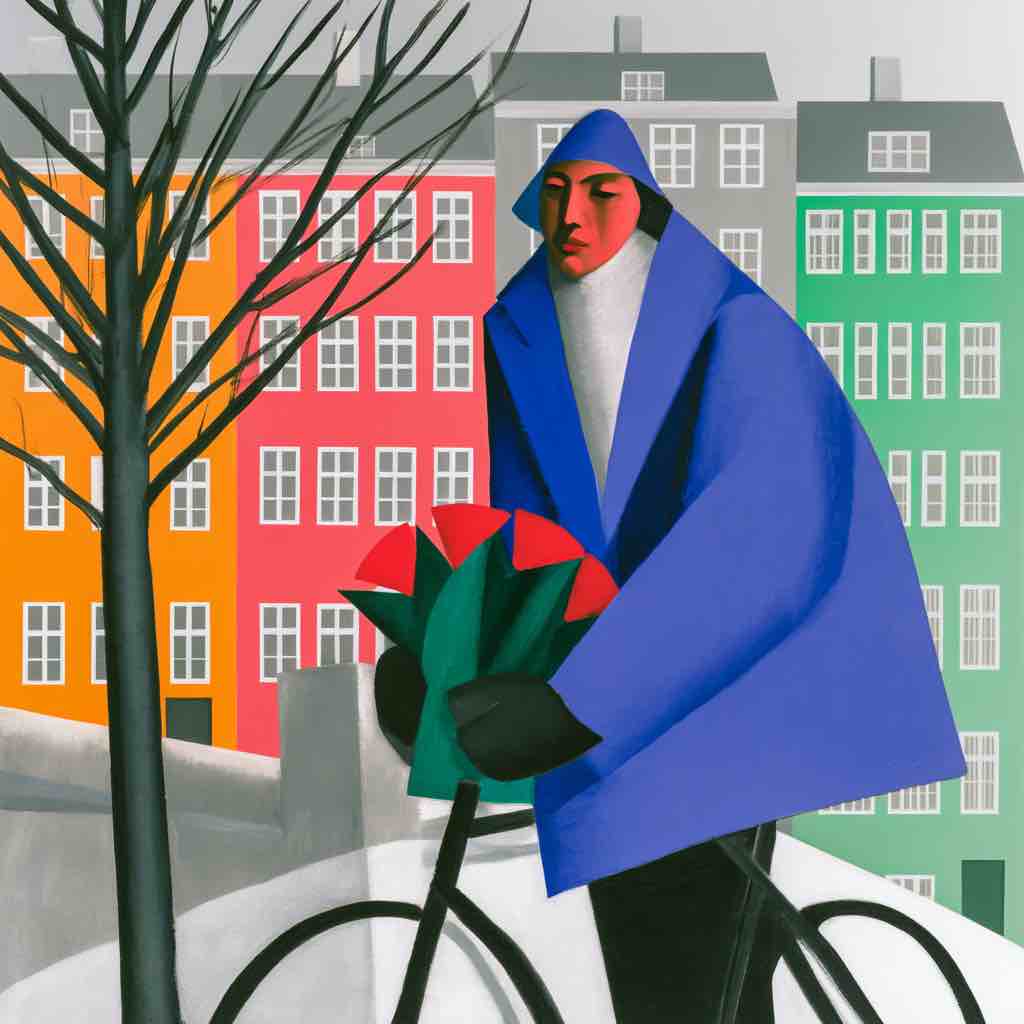
Hygge is an industry in Denmark.
The concept of hygge, which is usually translated as coziness or contentment, isn’t unique to Denmark – the Germans and the Dutch have similar words – but the marketing is unique to Denmark.
You can buy hygge books or pillows or candles or blankets. I recently saw a hygge card game for sale.
Hygge is unambitious enjoyment
Quite frankly, I think a lot of this is nonsense.
I always define hygge as “unambitious enjoyment”, or “inexpensive fun with people you like.”
Hygge is also a verb, so you can hygge with your family, with a few close friends, or even by yourself, with a cup of hot chocolate and a good book.
Hygge is wonderful when you feel included, but it can be pretty sad when you feel excluded.
Feeling outside of hygge
Feeling outside of hygge is quite common this time of year, when the nights are long and dark and any sunlight you get is weak and pale.
The mornings are often dark and rainy and the atmosphere is a thick, soupy grey.
You feel sløj, or sluggish, and it can be hard to motivate yourself to get out of bed.
Less welcoming to foreigners
For internationals, people who are in Denmark without a family network or a network of friends, it can be particularly tough.
Especially this year, when there have been massive layoffs at companies like Novo Nordisk and Vestas, where a lot of internationals are employed.
There’s no doubt that Denmark is less welcoming to foreigners than it was even five years ago. The prime minister has been in the media saying she thinks Denmark is for ethnic Danes.
Citizenship wait
And there are thousands of people who have applied for Danish citizenship, taken the tests, paid the fees, done all the things they are supposed to do, now waiting in line while the Danish government makes up its mind about new citizenship requirements.
I recently attended an event with an agency that’s charged with bringing international talent to Denmark, and I asked one of the speakers, “How do you recruit people while at the same time telling them they’re not really welcome?”
The guy didn’t have an answer.
The only person not invited to the party
Anyway, you can feel like you’re on the outside of hygge when you’re newly arrived in Denmark, but you can also feel on the outside of hygge when you’ve been here a long time, as I have.
A couple of years ago I worked in a shop at Christmas time, which I like to do. It’s fun. In January, when the rush was over, there was an employee holiday party.
Everyone was invited to this party, except me, the only foreigner.
Officially this was because I was a temp, but the other temps were invited to the party.
The party took place after a workday, in which I had to sell my colleagues clothes and jewelry to wear to the party, which I wasn’t invited to.
My colleagues would say things like, “I’m going to wear this tonight, don’t you think it’s cute?” Uh, yeah, I do, but I won’t see you in it.
Oh well, I found another shop job the next year, with nicer people.
Were they going to the pub without him?
I do think when foreigners are excluded in Denmark it’s often because of a misunderstanding.
One Dane who had hired a British guy for his team told me recently that the British guy thought that when Danes left work at 4pm they were all going to the pub, without him.
That’s not the case at all. They were just going home, or going to pick up their kids before the kindergarten closed.
It’s just easier to hang out with other Danes
And inertia is also a factor. I was recently invited to a roundtable at which a local Danish politician said that his son played on a multicultural soccer team in a very international part of town.
Yet the politician said that when he came to sit in the stands and watch the kids play, he found himself gravitating towards the other Danish parents.
“It’s just easier,” he said. “I don’t have to figure out how to formulate what I have to say in English.”
Making internationals feel welcome
But there are people trying to make internationals feel more welcome, too. One businesswoman at the event said that at her company, the language is always English, even when two Danes chat with each other over lunch.
She said that was a little awkward, but that maybe a non-Danish speaker a couple of seats away at the lunch table would be able to participate and not feel excluded.
She said the company also spent a lot of money on social events, since for newcomers, their colleagues were often the only social circle they had.
So it is possible to invite people into hygge.
Invite someone who’s on the outside of hygge
Keep that in mind this holiday season, when there are so many parties and festivities, and some people might feel excluded, even you.
If you can, invite someone who might feel like they’re on the outside.
And if you’re the one feeling lonely, take action. I know Facebook is out of fashion, but there are a lot of groups for internationals on there, offering meetups, nature walks, holiday craft afternoons, board game events, whatever you’re into.
Hygge is a verb, you have to be active to make it happen.