Browsing Tag

seasons

Everyday life in Denmark book
Books, Stories about life in Denmark, The Danish Year

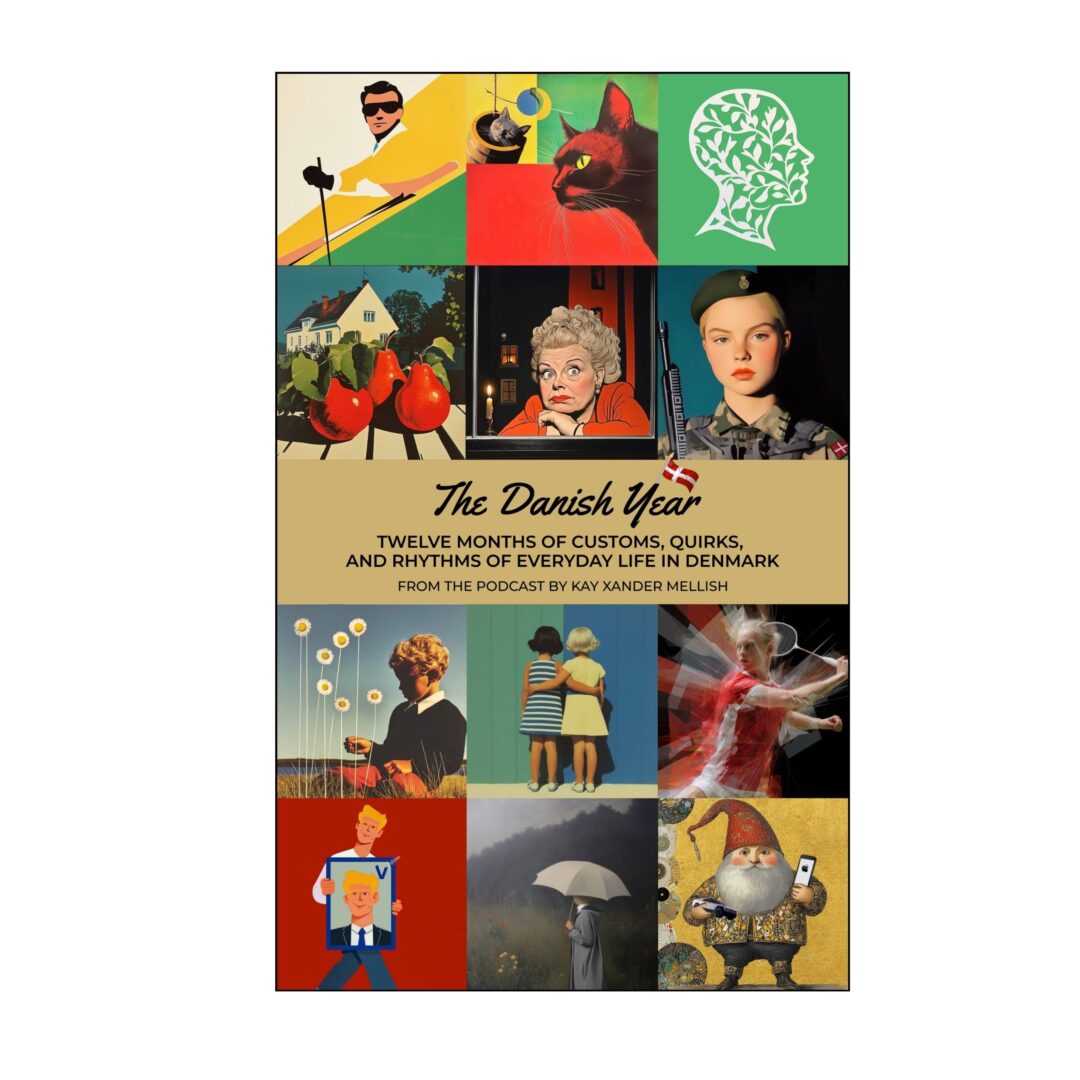
New Book! The Danish Year, 12 Months of Customs, Quirks, and Rhythms of Everyday Life in Denmark

Why do Danes “hit a cat out of a barrel” in February, set a single candle in the window in May, disappear for three weeks in July, and set out a bowl of porridge for a mythical “nisse” in December?

What are the aspects of the Danish year that aren’t on any calendar?

You’ll find the answers to these questions and so much more in our new book, The Danish Year: Twelve Months of Customs, Quirks, and Rhythms of Everyday Life in Denmark, available exclusively on Amazon Kindle for only DK35/USD 5.

(If you don’t have a Kindle, you can still read this short book on your tablet or phone using the Kindle app.)

Why is this book electronic-only?

After more than 10 years of putting out print books, I’ve chosen to debut this one as electronic-only on Amazon Kindle.

Why?

🔴 It’s short – only 89 pages – and going online allows me to sell it at a modest price that’s within most people’s budgets. And online publication allows for color illustration, which would make a print book very expensive.

🟡 Short books fit the way people read now. Our attention spans are fractured, sadly, and as a passionate reader myself, I have plenty of half-read books around the house.

The Amazon Kindle app allows people to read the book wherever and whenever they have time, on their tablets, phones, and or Kindle readers if they have one. (I do.)

🔴 Online books can be revised as circumstances evolve. Although this book isn’t really a news book, small facts do change (such as the name of the Danish prime minister), and it’s nice to be able to revise information that would otherwise make the book look dated.

New strategy

My new strategy is this: as opposed to writing one big book every few years (How to Work in Denmark, my previous book, came out in 2022) I plan to write 1-2 short books per year.

Some will also be published on paper, and some will just live online as part of my new “𝐇𝐨𝐰 𝐭𝐨 𝐋𝐢𝐯𝐞 𝐢𝐧 𝐃𝐞𝐧𝐦𝐚𝐫𝐤 𝐬𝐡𝐨𝐫𝐭𝐬” series on Amazon.

November Rain Denmark Danish Year Podcast
Podcasts, Stories about life in Denmark, The Danish Year

November Rain and “daylighting” buried rivers: The Danish Year Part 11

I’ve referred to “The Danish Year” before on How to Live in Denmark. It’s a series of events that are simply expected to happen every year in Denmark, even if they aren’t formal holidays. In 2025 I’m going to try to do a podcast every month about aspects of the Danish year, and how they fit into the overall context of where Denmark is coming from, and where it’s going.

I always thought November was the rainiest of Danish months, but it isn’t, actually. That’s October. But November feels rainier, because the sky is so grey, and it gets dark so early, and the rain sometimes comes down in little freezing pellets.

Denmark is a watery country, not just its long coastline and many rivers and lakes, but also the fact it is mostly near sea level. Like the Netherlands nearby, it is extremely vulnerable to flooding.

Climate changes in recent decades have made it worse, and sudden cloudbursts – or skybrud– cause a lot of damage.

So retrofitting Denmark for even more water in the future has become a national obsession.

Officially, a skybrud or a cloudburst is defined as more than 15 millimeters of rain in less than 30 minutes, or 3 centimeters of rain in an hour. In these intense downpours, there is so much water that the soil and the drainage systems can’t absorb it.

Continue Reading

Paerdansk Pear Danish by Kay Xander Mellish
Podcasts, Stories about life in Denmark, The Danish Year

April, Gardening in Denmark, and what it means to be “Pear Danish”: The Danish Year Part 4

I’ve referred to “The Danish Year” before on How to Live in Denmark. It’s a series of events that are simply expected to happen every year in Denmark, even if they aren’t formal holidays. In 2025 I’m going to try to do a podcast every month about aspects of the Danish year, and how they fit into the overall context of where Denmark is coming from, and where it’s going.

As the long Danish winter finally draws to an end, it’s time for Danes to start planting their gardens.

Now, in early April, it’s rhubarb, parsnips, cabbage. After the risk of frost is gone, in late April, you can put down some beets, and chives, and parsley – all good traditional Danish food.

By May, you can try with the tomatoes, which may or may not ripen depending on whether you get a warm, sunny summer, always a roll of the dice in Denmark. One year we ended up with hard, green tomatoes in September.

The growing season in Denmark is short. If you miss the planting deadlines, you’re probably out of luck.

And even if you are in luck, the amount you spend at the garden center will far outstrip the amount it would take you to buy the same foods at the corner market.

Names that include “gaard”

But Danes love to garden, they love to touch the Earth. Denmark industrialized fairly late compared to the rest of Europe – really not until the late 19th century – and even then it focused on cooperative agriculture for export. Denmark is still known around the world for its butter and bacon.

Many Danes still carry the name of their family farm in the name they use today.

The Danish word for farm is “gaard”, so the names of jewelry designer Ole Lynggaard, or golfer Nicolai Højgaard, or politician Pia Kjærsgaard, all reference what was once the family farm, the “gaard”.

Continue Reading

Gækkebrev Danish traditions vs Digitalization
Podcasts, Stories about life in Denmark, The Danish Year

March, Gækkebreve, and the things lost in Digital Denmark: The Danish Year Part 3

I’ve referred to “The Danish Year” before on How to Live in Denmark. It’s a series of events that are simply expected to happen every year in Denmark, even if they aren’t formal holidays. In 2025 I’m going to try to do a podcast every month about aspects of the Danish year, and how they fit into the overall context of where Denmark is coming from, and where it’s going.

“Am I being threatened?”

An international professional newly arrived in Denmark asked me this when he received a note in his apartment building mailbox. Now, this alone is unusual in Denmark. Since everything went digital about 10 years ago, we get very little paper mail. I don’t think I’ve received anything in months.

But he had. He had received a carefully decorated envelope, illustrated with crayon, in which there was a single piece of white paper, cut into a kind of snowflake pattern.

It had some Danish writing on it, a few short lines, maybe a poem. And it wasn’t signed…there were just a few mysterious dots.

The man, a highly educated engineer, was concerned. “Am I going to be kidnapped?” he asked me. “Is this some kind of ransom note?”

Gækkebrev are an old tradition

No worries, he was safe. What he had just received was a gækkebrev, or gække letter, named after the vintergække flower that used to come with these letters in the 1800s.

GækkebrevGækkebreve arrive just before Easter, and they are always carefully cut from a single piece of paper, usually in an elaborate pattern. The poems are usually standard, copied from a book, and they are anonymous, but the mysterious dots they are signed with correspond to the number of letters in the sender’s name.

So if I sent you a gækkebrev, I would sign it with three dots, for K-A-Y.

If you can guess who sent the letter, I owe you a chocolate Easter egg. If you can’t then you owe ME a chocolate Easter egg.

Thus, gækkebreve are very popular with small children looking for candy.

My guess was that maybe this engineer had a young child or young neighbor who might have made this at school. And he did.

Traditions vs. digitalization

Gækkebreve are a great Danish tradition, but like many other Danish traditions, they are fighting with the country’s ambitious digital agenda.

Continue Reading

Podcasts, Stories about life in Denmark

Finding light in the Danish winter darkness

I frequently work with internationals who have arrived in Denmark from sunny countries like India, the UAE, and the Philippines, and they all share one common challenge – finding light in the Danish winter darkness.

Actually, Danish people struggle with it as well. The darkness that starts to fall in the early afternoon means that 5pm looks just like 8pm, which looks just like midnight, which looks just like 5am, which looks very similar to 8am. Dense, inky black sky.

During the daytime there’s a dim grey light, sometimes accompanied by a soupy fog of tiny raindrops. It’s tough to handle.

“Sløj”

Many people living through this time in Denmark describe feeling low-energy – sløj is the very descriptive Danish term. It translates directly to “sluggish”. Others feel deeply depressed. Some eat too much, or drink too much. Some sleep all the time.

It doesn’t have to be this way. Here are my tips for handling these dark months, which generally stretch from November until the end of February.

Continue Reading

Podcasts, Stories about life in Denmark

New Year’s Eve traditions in Denmark

It’s almost Week 1, in the weekly numbering system that’s widely used in Northern Europe, where the year starts with week 1 and runs through to Week 52 or 53, depending on the calendar.

It’s very efficient for planning, so you don’t have to say something messy like “What about that week that starts Monday June 3…” Week 1 starts on January 1, and everything follows that in perfect order.

But before that we have New Year’s Eve, a day that fills me with trepidation to be honest, because in Denmark, New Year’s Eve is all about amateur fireworks.

Cannonballs, Roman Candles, Ding Dongs, Triple Extremes – these are what you can purchase to set off yourself in a local parking lot, terrifying any nearby dogs or cats.

Having a family member in the hospital business, I can’t help but think that today, December 26, there are a few amateur fireworks fans who have perfectly well-functioning eyes and fingers who won’t have them on January 2.

Continue Reading

Danish summer vacation
Podcasts, Stories about life in Denmark

No ice cream in July: Scenes from the Danish summer vacation period

In Denmark, the right to a long summer vacation is enshrined into law – the national vacation law, which states that all employees have a right to three weeks’ vacation between May and September.

July is peak vacation time, and some companies close down entirely for a week or two, forcing their employees to take some time off.

Shops close, too. An ice cream shop in my neighborhood closed down for the entire month of July last year. You would think this would be peak time for ice cream, but for the owners of the ice cream shop, their own vacation was more important.

Bicycle shop closes

This year, I noticed that the bicycle store up the street is closed for three weeks – hope you don’t get a flat while out biking in the summer sunshine. So is the local “smørrebrød” sandwich shop. (Too bad about your picnic.) Even a local boutique selling swimwear is taking a summer break.

Danes believe that if you take a good, long, Danish summer vacation, you’ll come back refreshed, with new perspectives.

Free time is precious in Denmark – certainly more important than prestige, since people don’t generally use their job titles, and far ahead of money, since whatever you have the government will be taking a big bite out of. Free time is cherished, free time is wealth, and that’s one of the reasons the summer vacation is so prized. 

You’ll often hear Danes ask each other how many weeks they’re taking for summer vacation. “So, this year, are you taking 3 or 4?”

Continue Reading

Podcasts, Stories about life in Denmark, Travels in Denmark

Danish beaches in winter: White light and bitter wind

It might seem like a counterintuitive time to talk about beaches, in the middle of a long, very cold winter.

But in these times of COVID, beaches are one of the few places in Denmark you are currently allowed to meet up with family and friends.

Beaches, parks, frozen-over lakes, these are the big social meeting points at time when cafés, restaurants, bars, shops, gyms, schools, theaters, museums, places of worship, and hairdressers, barbers, and nail salons are all closed.

Continue Reading

Stories about life in Denmark

Danes and Boats

Denmark is a boating nation, from the days when the Vikings built innovative ships to the present, when the coast is dotted with marinas for pleasure boats.

The country has won 30 Olympic medals in sailing – 12 of them gold. That’s more than it has won in any other sport.

And many of the comforts of the Danish welfare state were paid for by the (now reduced) profits of Maersk, the world’s largest operator of container ships.

Continue Reading

Podcasts, Stories about life in Denmark

Summer vacation in Denmark: The agony and the ecstasy

Planning your summer vacation in Denmark is like playing the lottery. You could hit it lucky, with golden days and long, warm evenings, when you can sit with friends in the soft light and drink hyldeblomst cocktails.

Or you could get grey day after grey day, interspersed with a little rain whenever it is least convenient. The weather could be chilly, leaving your cute new summer clothes to sit disappointed in your closet while you wear your boring long trousers again and again.

Continue Reading