Browsing Tag

men

Danish bakeries in Denmark Bakeries and the Danish soul
Podcasts, Stories about life in Denmark

Bakeries and the Danish soul

I occasionally work with small children in Denmark, one of my many side gigs, and on a recent rainy afternoon, I taught a couple of boys how to play tic-tac-toe.

This simple game of putting marks in a 3 by 3 grid may seem dull to adults, but to a four year old who has never seen it before, it’s a revelation.

The strategy! The many ways you can win! It’s an ancient game that can still be fascinating to someone born in 2022.

Tic-tac-toe is played all over the world under various names – it’s noughts and crosses in Britain, it’s maru-batsu (“circle-cross”) in Japan.

And in Denmark, it is kryds og bolle, crosses and buns.

Buns, bolle, are the basis of a Danish breakfast.

Bolle not bølle

And remember to always say bolle, which means bread roll, and not bølle, which means bully.

That confused me for many years, as did slang term at bolle, which is a vulgar term for sex.

(Princess Isabella, the 19-year-old royal rebel, recently appeared at a music festival with a band t-shirt that said Bollede ham i går, I slept with him last night, with a big arrow pointing to the right.)

BMO is a bun with cheese

Anyway, the bread version of bolle is the basis for most Danes’ breakfast.

Danes are not fancy breakfast eaters. The first meal of the day is either a bolle with cheese, known in trendy terms as a BMO, or bolle med ost, or some oatmeal.

A visiting American recently asked me where he could go out for breakfast, since of course we Americans have elaborate breakfast restaurants, and the only place I could send him was Grød, a specialist oatmeal chain.

Getting breakfast from a bakery

Many Danes will get their breakfast from a bakery.

Perhaps a nice fresh loaf of sourdough for slicing, or one of the many types of bolle – maybe a rundstykke, or round piece, a nice crunchy wheat roll. They might get one of the newer types of bolle, like a müslibolle.

Or they might get Danish rye bread, rugbrød, that dense, delicious taste of Denmark every Dane misses most while living abroad.

On a Friday or a weekend, they might pick up a few sugary Danish pastries, known as wienerbrød, or Vienna bread. Cinnamon snails, kanalsnegle, or cardamon buns are popular with all ages.

Bakeries were dying

Fifteen or twenty years ago, bakeries in Denmark seemed to be dying.

They couldn’t find staff. Nobody, it was said, wanted to get up in the middle of the night and make bread.

The few bakeries that were left tended to have dirty windows and sour service and offer stale, dusty pastries.

Most Danes made their breakfast bolle at home or got frozen buns from the supermarket or gas station.

I remember a text about gas station buns at one of my early Danish language textbooks.

Destination bakeries

But the trend has turned, and bakers and bakeries are now some of the hottest businesses around.

People will wait in line outside the Juno bakery in Copenhagen, or Bakeria in Helsingør. These are destination bakeries.

And this is not just a big city phenomenon. There are craft bakeries all over Denmark. This year’s Best Bakery contest has 80 nominees from Aalborg to Rønde to Jyderup to Karrebæksminde.

Baking is macho in Denmark

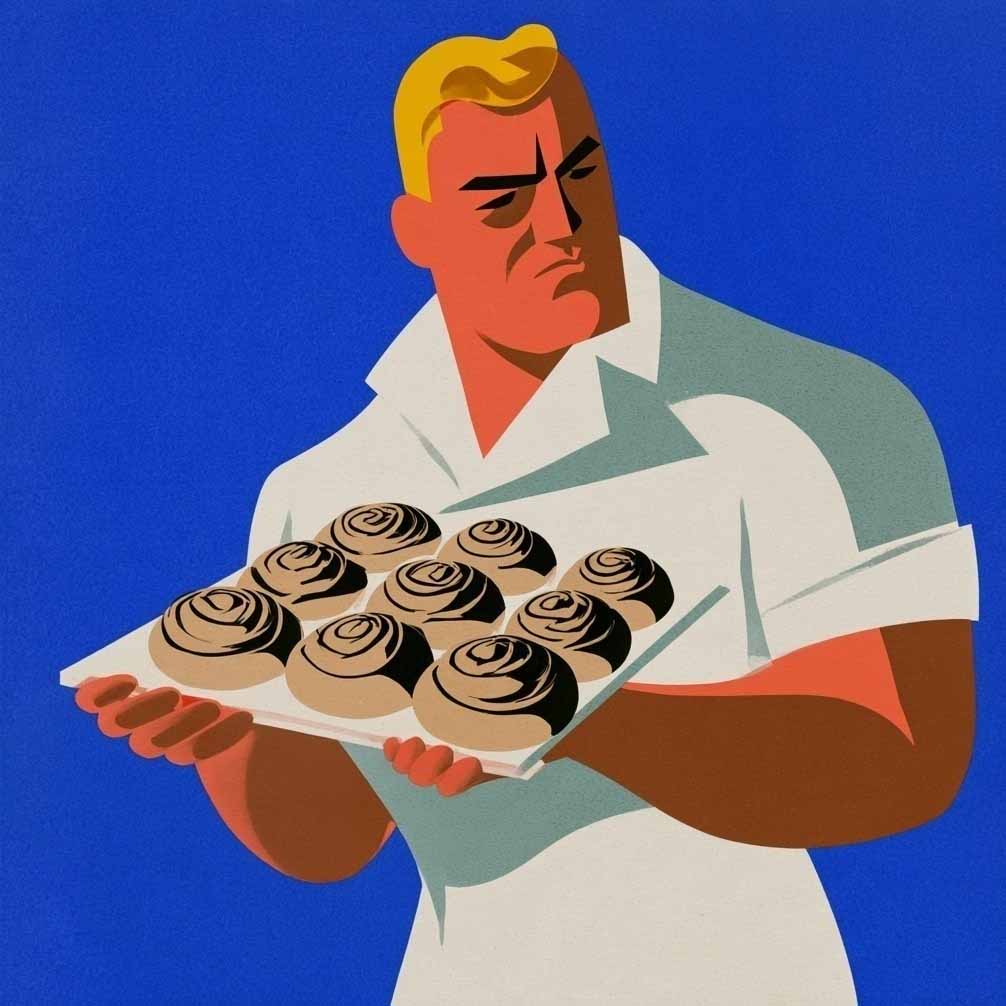
Perhaps it is a coincidence, but the trend turned when baking became a rather macho enterprise in Denmark. Claus Meyer was the pioneer, with his Meyers Bageri.

Baking became a way for Danish men, who are generally gentle fellows, to show their creativity and skill. This is a culture that respects craft and handiwork, whether it is furniture making or beer brewing or silversmithing, or producing a beautiful bun.

An acquaintance of mine recently ran a baking course for teenagers, and all of the sign-ups were boys.

Fancy craft bakeries

Many of these men go on to create fancy craft bakeries, where a complex bun or piece of cake can cost an absurd amount.

These bakeries reflect the confidence and prosperity of Denmark at this time in history.

Thirty or forty years ago, this was not a country where people had a lot of disposable income. Now it is.

Buns are still an equalizer

Yet the Danish bolle, made with yeast and flour and water, is still an equalizer.

Everybody can afford the most simple version, which usually costs less than 20 crowns, and everyone with an oven can make them at home.

Even you, wherever you are.

They’re hard to mess up. You just have to give the dough enough time to rise.

That means that baking bolle is something someone of any age can enjoy, just like tic tac toe.

Podcasts, Stories about life in Denmark

Gender equality in Denmark: A story of mixed results

Denmark has had two female prime ministers and about forty percent of the people elected to the Folketing, the Danish Parliament, are women, which one might think is a good indicator of gender equality in Denmark.

But when it comes to private industry, Danish women have one of the lowest participation rates in management in Europe. According to the OECD, only 26.9% of managers in Denmark are female, compared to 40.7% in the US.

It’s not unusual to see a senior management team made up entirely of Danish males, with perhaps a Swedish or German male thrown in for diversity.

Continue Reading

Stories about life in Denmark, Working in Denmark: Danish Business Culture

Finding a job in Denmark as a foreigner: Some tips from my experience

If you’re a foreigner, finding a job in Denmark is not easy, but it can be done. It depends a lot on what you can do. And what you can do better than a Dane. Because, let’s be frank here, if all things are equal between you and a Danish person, they’re going to hire the Danish person.

The Danish person knows the language, the Danish person knows the culture, the Danish person knows not to bring Brie cheese to the Friday shared breakfast. In every Danish office I’ve ever worked in, there’s been a Friday shared breakfast, and they always eat exactly the same cheese. Sliced, medium-sharp Riberhus Danbo cheese.

Continue Reading

Podcasts, Stories about life in Denmark

Danes and Spring: Hot wheat buns and highly-educated drunks

 
It’s spring in Denmark, and spring is by far my favorite season here. The wonderful white Scandinavian sunlight is back after the dark days of the winter, the flowers are coming out on the trees, and everybody’s in a good mood. The outdoor cafés are full of people again – sometimes draped in blankets to keep warm, but outside all the same.

April and May are often the best months for weather in Denmark, along with September. Summers can be rainy. And April is when Tivoli opens in Copenhagen. (Side note: when you see a man in Denmark with his trousers accidentally unzipped, you quietly inform him “Tivoli is open!”)

Tivoli is one of the world’s great non-disappointing tourist attractions – it’s constantly updated, with new shops, new rides, fresh flowers and fresh restaurants. And in the spring, it’s not as crowded as it is in the summer. You can hang out all day, have a picnic, ride the rollercoaster, even hear some bands play.

Continue Reading

Podcasts, Stories about life in Denmark, Working in Denmark: Danish Business Culture

Job Hunting in Denmark Part 2: Putting together your Danish cv

I’ve applied for jobs in Denmark and been hired; I’ve also been the person doing the hiring and sorting through applications.

Here’s the truth: It’s really no fun on either side. On the applicant side, you can feel like a beggar, desperate for someone to recognize and reward your talent. It wears on your confidence, particularly in a long hiring process, which is common in Denmark even for Danes.

And on hiring side, you’re facing a huge stack of applications, mostly from people who know nothing about the company, nothing about the job, and are sending you a standardized letter or cv that gives no indication about why they’re a good fit.

For example, when I was hiring for a copyediting position at a financial company in Copenhagen, I got a letter in flawless English from an Eastern European woman who was a display artist at IKEA. She put together the sofas and pillows to give the imitation living rooms a chic and homey atmosphere. It’s noble work, but it had absolutely nothing to do with the job we had advertised, and she’d given no indication of how her skills would transfer.

Continue Reading

Dating, Podcasts, Stories about life in Denmark

How to date a Dane: The two-speed bicycle and the flexible word

My Danish friends who are about to spend some time in the U.S. often ask me for advice about surviving American culture, and I give them all the same two tips.

First, in the U.S. it’s a good idea to be polite to police officers. Danish cops often come from the countryside and have funny rural accents and since Danes generally don’t like hierarchy and authority anyway, they have no problem being sarcastic and a little smart-ass with a police officer.

That doesn’t work in the States. That Highway Patrol lady with the mirrored sunglasses who has just caught you speeding down Route 66 is unlikely to have much of a sense of humor. If she pulls you over, say “yes, ma’am” and “no, ma’am” a lot and keep your hands in view at all times so she can see you’re not reaching for a gun.

That’s the first tip. The second tip is that, should you go to a bar, it can happen that a stranger or two will offer to buy you a drink. If the stranger is of the opposite gender, or same gender depending on the bar, that person is interested in you. Let them buy you a drink. And chat with them while you drink it. If there’s no chemistry, when the drink is finished, you can both go your separate ways.

That’s a little shocking for Danes. Buying a drink for someone is a big deal in Denmark, a place where a loving couple who go out for a romantic candlelight dinner often split the bill. For Danes, buying someone a drink is like buying them a birthday present. Many Danes are not comfortable with a stranger making that level of commitment.

Continue Reading

Podcasts, Stories about life in Denmark

Danes and Beauty: Miss Denmark, the empty museum, and why you shouldn’t expect compliments

I get a little local newspaper in my mailbox every week, and this week – in between the usual stories about which local project has been able to squeeze the biggest subsidy out of the Copenhagen city government – there was an article about the Miss Denmark pageant.

Two teenagers from the neighborhood, one an ethnic Dane and one of Middle Eastern descent, had been selected to represent us in the pageant.

Now that surprised me. I’ve lived here for 15 years, and I’d ever even heard of the Miss Denmark pageant. Denmark is usually not the sort of place where women in bathing suits walk around while fully-dressed men debate their merits.

And quite frankly, most Danes are less interested in the beauty of people than the beauty of things.

Continue Reading

Podcasts, Stories about life in Denmark

Arriving in Denmark: Some tips from my experience

August in Denmark brings the first signs of fall: a crisp chill in the air, the changing color of the leaves, the annual posters warning drivers to be aware of small children riding their bikes to school for the first time.

And foreign university students in the local 7-11, asking that their buns be warmed up.

I saw a newly-arrived young American student in my local 7-11 this morning, asking that her newly-purchased bun be warmed. The 7-11 clerk told her sorry, but there were no bun-warming services available at that branch.

She wasn’t too pleased, but it’s always a mistake to expect U.S., U.K., or Asian-level concepts of customer service in Denmark: in this egalitarian country, nobody serves anybody, and if they do they are frequently grumpy about it. You and the store clerk are equals, and nobody’s going to warm anybody’s buns unless it was agreed to in the original deal.

Continue Reading

Podcasts, Stories about life in Denmark

Danish babies: Rolling royalty and tribal names


Denmark is a small country, and Danish people tend to think small things are good. Small cars. Small homes. Small ambitions when it comes to international team sports. But one thing in Denmark is never small – a baby carriage.

Danes seem to believe that a carriage (or pram) for a new baby should be roughly the size of a hotel room on wheels.

Inside, baby will be wrapped up warm with a fat feather blanket – even in the summer. There will also be room for pillows, books, toys, snacks, diapers and extra clothes in the giant baby carriage.

Danish babies are like rolling royalty. Everything they need is at their tiny fingertips.

Continue Reading

Podcasts, Stories about life in Denmark

Danes and Singing: Danish drinking songs, party songs, and foreigners who try to hum along

There have been very few international singing stars from Denmark, and that’s a surprise, because Danish people love to sing.

Joining choirs is very popular, and Danish schoolchildren often start the week with a song – in my daughter’s school, all the grades get together and sing something from the school’s common songbook.

There’s actually a kind of common songbook for all the children of Denmark, called De Små Synger, where you can find classics like Se Min Kjole (See my dress), Lille Peter Edderkop (Little Peter Spider) or Oles Nye Autobil, (Ole’s new car). Ole’s new car is actually a toy car that he uses to run into things, like his sister’s dollhouse. De SmÃ¥ Synger

In general, the Small Songs are a throwback to an older Denmark, a quieter Denmark where most people lived in the countryside. Many of the songs refer to green hilltops, or forests, or baby pigs or horses, or happy frogs that live in a swamp. And of course, all the humans in the Small Songs are entirely Danish – or ‘Pear Danish,’ as the local expression goes. One out of five children born in Denmark today is not an ethnic Dane, but there’s no such thing as Little Muhammed Spider or Fatima’s New Toy Car.

Continue Reading