
Some might say that the most Danish piece of furniture is the chair. The Swan Chair, the Egg Chair, the Wishbone chair. They’re all international design classics. You can buy a poster with 100 of the top Danish chairs, and if you go to Designmuseum Danmark there is a hall of chairs you walk through, the display cases stacked three high. Chairs, chairs, everywhere.
But I think the most Danish piece of furniture is the table. It is where traditional Danish cuisine is enjoyed, and sitting around the table, and sitting and sitting and sitting there for hours after a long meal, is where hygge reigns and people are included – or excluded, as the case may be.
Inclusion based on the number of chairs
I’ve mentioned in many of my presentations that in warm countries, like in Southern Europe, if you’re inviting people over for dinner, it’s a casual, open invitation.
We’re having chicken. Come on over. Oh, I can’t, my cousin is here. Well, bring your cousin! But his girlfriend is here too. Bring your cousin’s girlfriend! We have lots of chicken.
Danish dinner party customs are different. We have 8 chairs at our table, and there is room for 8 people. There’s no chair for your cousin.
A dinner invitation in Denmark is an honor
A dinner invitation to someone’s home is an honor in Denmark, and people often dress better for it than they might dress for work. Ladies put on a pretty ruffled blouse, men might wear a suit jacket or at least a shirt with buttons. And everyone arrives precisely on time. There’s no such thing as fashionably late in Denmark.
For a dinner party like this, the host or hostess will set an elaborate table. There will be cloth napkins in napkin rings, probably some candles, maybe a few carefully chosen flowers as a centerpiece – not so many that you can’t see the person on the other side of the table.
And there will be different glasses for different drinks. Water glasses, wine glasses, and often tiny little glasses for toasting with aquavit.
Setting a beautiful table is a Danish art form.
And dinner parties are usually a very good time to bring out the Royal Copenhagen dishes.
Royal Copenhagen dishes are a tradition
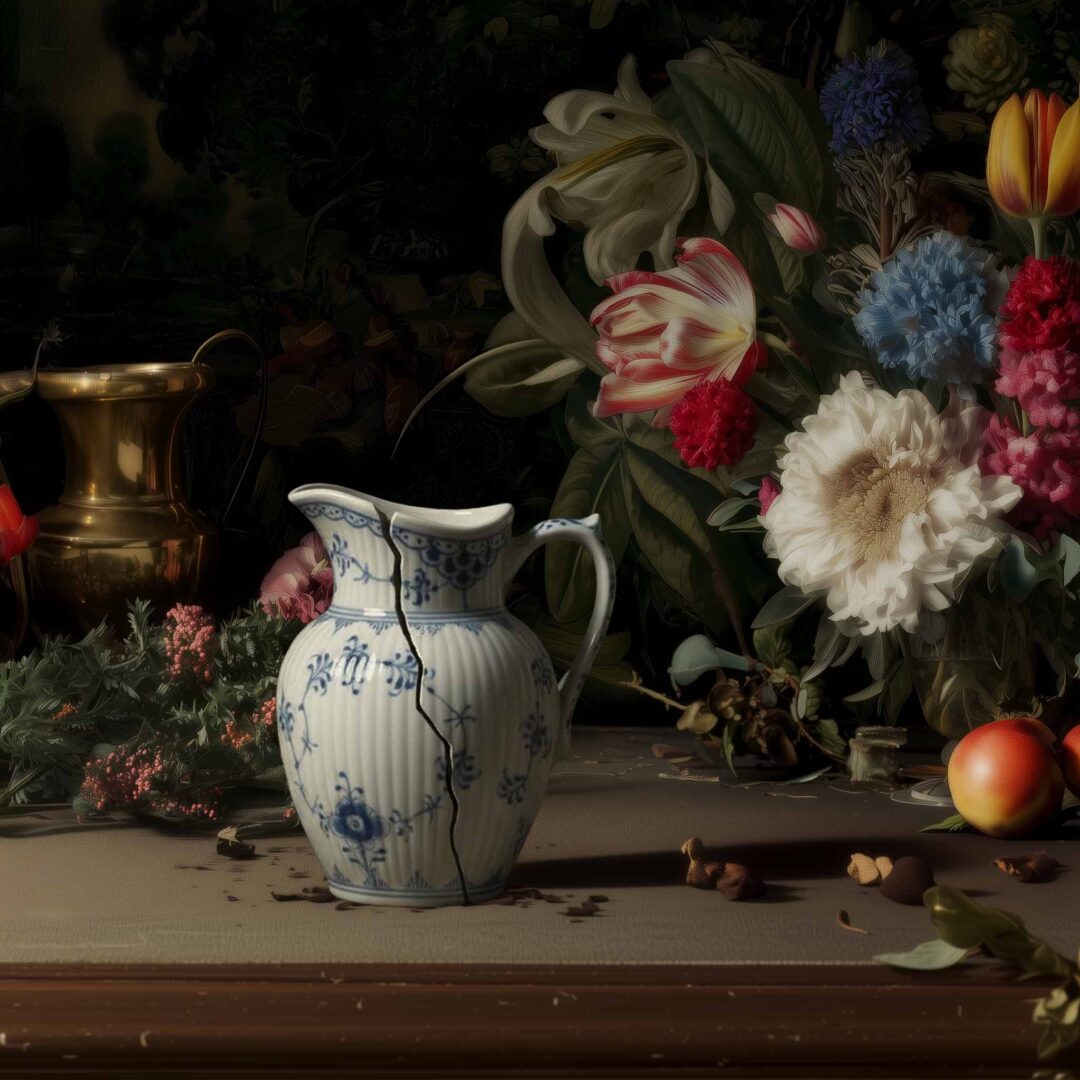
You can’t talk about Danish tables without talking about Royal Copenhagen, that blue and white porcelain first produced in 1775.
At the time, porcelain was a real marvel. It’s hard to believe now, when we’re all so used to looking at antique shops full of unwanted plates and kitschy porcelain figurines, but at the time, porcelain was the stuff of kings.
Porcelain was invented in China, and the Europeans tried but were unable to duplicate it until 1710, when inventors in Meissen, Germany figured out a local version. By 1775, Denmark had entered the porcelain business and Queen Juliane Marie started up the Royal Porcelain Factory.
It immediately started making blue and white plates similar to the ones on sale today – white with hand-painted blue flowers. The blue comes from a cobalt mine in Norway, which at the time was part of the Danish kingdom.
Updated Royal Copenhagen patterns
If you think Royal Copenhagen porcelain is just for tourists and ladies of a certain age, think again. It is hugely popular among young people. I work part time in a shop and I sell a lot of Royal Copenhagen porcelain to women in their 20s.
That’s because of two great business decisions. First of all, Royal Copenhagen, which is now owned by a Finnish company, keeps updating its patterns.
The hand-painted blue dishes most people buy now are not the hand-painted blue dishes grandma used to have with their little bitty lacy patterns, although you can still get those if you want them.
But the most popular patterns now are bigger and bolder, yet still in the same cobalt blue. And you can put them in the dishwasher.
Royal Copenhagen breakage guarantee
Secondly, in a strategy that should be studied by marketing students, Royal Copenhagen dishes have a breakage guarantee. If one of your fancy porcelain dishes breaks within two years of purchase, you get a new one for free.
This is to encourage people to actually eat off their plates, and use their coffee cups for coffee, instead of stashing them in a glass cupboard where people will look at them and dust them but never use them.
A gift to start the collection
If you’re Danish and are welcoming a new colleague to the country, or maybe the new international spouse of a Danish friend, a piece of Royal Copenhagen to start their collection is a nice gift.
A team of co-workers did this for my housewarming when I first got here. I still have it.
It was a nice gesture, implying that now that I was here in Denmark, I had a plate at the table, if maybe not yet a chair.