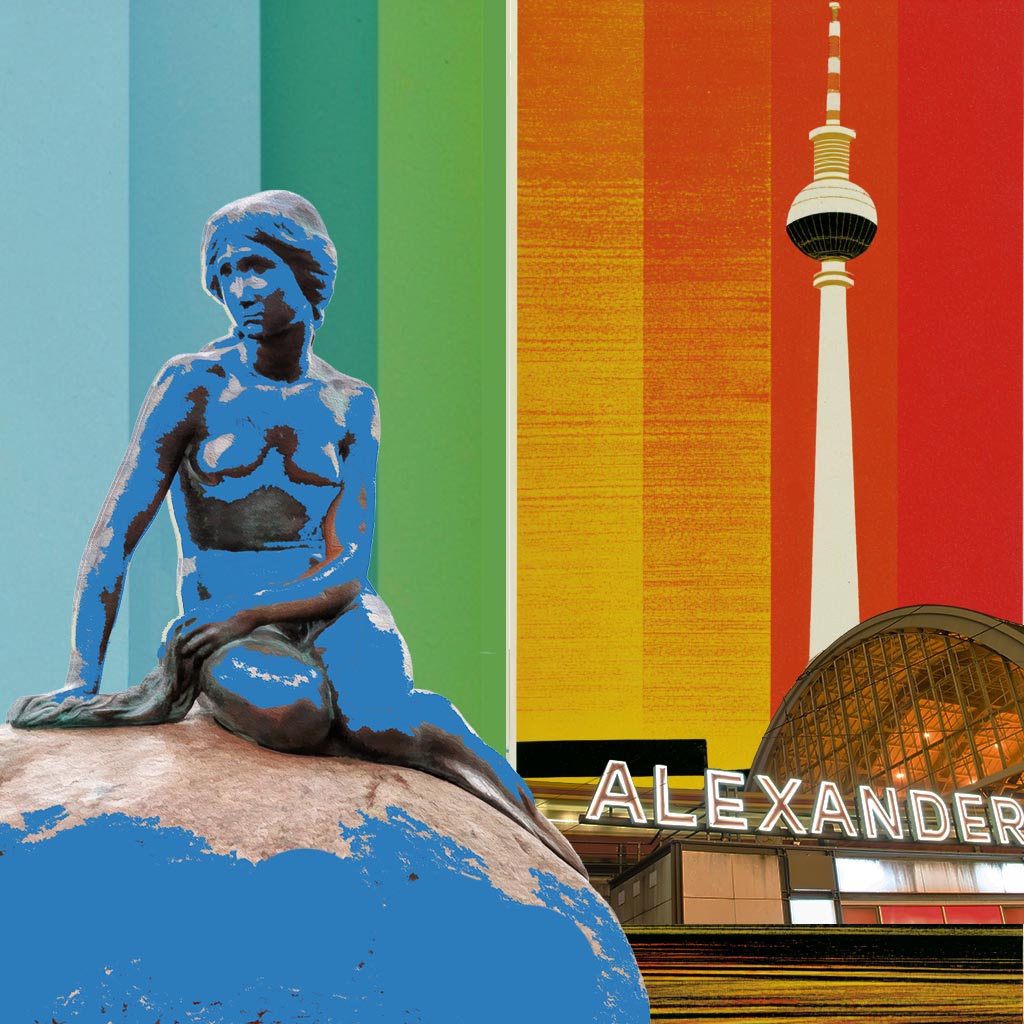
When I checked into my hotel on a recent trip to Berlin, I was surprised to find a little shop next door called Hygge. It was a Danish theme store, right in the middle of the German capital city. It had soft pillows, candles, wooden figurines, and other home items designed to create a cozy Copenhagen atmosphere in the raw rough streets of Berlin.
Of course, it’s not uncommon for one city to have tiny tributes to a different city. After all, Copenhagen has a Berlin Bar, and a clothing store called New Yorker, and an Old Irish Pub. But it inspired me to compare the two cities, Copenhagen and Berlin, two national capitals which are relatively close – less than an hour’s flight – but very different in spirit.

In my youth in Berlin
Those of you who have followed me for a while know that I used to live in Berlin, long before I lived in Copenhagen. This was when I was young and pretty, so quite some time ago, and at the time Berlin was a demilitarized zone, which meant that military draft notices could not be sent there.
That meant that a lot of young German men from around the country chose to live in Berlin as an alternative to joining the army, which meant that the male-to-female ratio at any party was very much in my favor.
Copenhagen vs Berlin
Berlin was fun and exciting then, and it’s fun and exciting now. It has much more of a nightlife scene than Copenhagen, being one of the capitals of techno music, and more of a classical culture scene too.
Berlin has eight symphony orchestras and three opera companies, in part because in the days when the wall was up and the city was split into West Berlin and East Berlin, there had to be an opera company on both sides, and symphony orchestras on both sides.
Berlin also has two zoos, one in the West and one in the East.
Copenhagen has one opera company, and one zoo.
Poet or punk
Berlin is just a bigger city, roughly twice the population, and it’s the capital of a bigger country. 84 million people in Germany versus 6 million people in Denmark. If you look at it that way, Copenhagen is culturally punching far above its weight.
Living in the two cities is very different. Copenhagen is a mostly clean, mostly safe, mostly well-run, mostly get up early in the morning and get to work type of city.
There’s not a lot of opportunity to opt out and be a poet or a punk, especially since reforms tightened the maximum term for unemployment payments to two years instead of four.
Long-term low-income lifestyles
Berlin, on the other hand, is more tolerant of long-term low-income lifestyles. There are a lot more government grants for artists. And until recently, Berlin also had much cheaper housing available than Copenhagen. That’s changing now.
And Berlin is not always clean and not always well-run. It’s a little scruffy. You’ll see overflowing trash cans, furniture dumped on the sidewalk, parks that aren’t very well-tended.
You’ll see many more rough sleepers in Berlin, people sleeping in train stations or under railway arches, or sometimes putting up a tent in a park. That’s rare in Copenhagen.
Traditional lunchtime foods
I was thinking about these contrasts as I waited in line at lunchtime at a trendy bratwurst stand in Berlin. Both the Danes and the Germans still seem to enjoy their traditional foods, especially at lunchtime.
You can’t beat a good piece of smørrebrød in Copenhagen.
Both Copenhagen and Berlin are modern cities strongly affected by their history. Copenhagen still has its medieval street plan, even if most of the brightly colored buildings are from the 1700s and 1800s. This helps give Copenhagen its fairy-tale feeling, its warmth, its hygge.
Berlin is not hyggelig. Its medieval street plan is long gone, and of course the city was devastated at the end of World War II. You can still find bullet holes from the Battle of Berlin in some buildings, like the old National Gallery in the center.
Big parts of the city were flattened, and the buildings that replaced some of the destruction weren’t very pretty. Parts of Berlin are actually ugly.
A friendly balance
As different as the two cities are, their residents are admirers of each other. Danes vacation in Berlin to get a taste of big city nightlife, Berliners often come to Copenhagen to enjoy the charm of Tivoli Gardens, and sometimes to get married. Copenhagen City Hall’s wedding rooms are beautiful, and there’s much less paperwork than there is in Germany.
Germans and Danes have been on the opposite side of several wars, but their two capitals, one secure, one a bit chaotic, now have a friendly balance.
They even name shops after each other.