Search results for

dating

Dating, How To Date in Denmark, Stories about life in Denmark

Dating Danish Women: A guide for the foreign man

I get a lot of mail from readers of this site, but a lot of the mail I get is on one particular topic.

Here’s one from this week, from Teddy in Ghana: I WANT TO KNOW IF DANES WOMEN WILL DATE A GHANAIAN MAN. I AM VERY MUCH INTERESTED. And one from last month, from Alex: “Hi, I’d like to know if Danish girls would date a bi-racial Brazilian guy.” And one from late last year: “I’m a gay African American male who would like to date a Dane. Any advice?”

Basically, a lot of the mail I get is from men, wanting to know how they can get some action in Denmark.

I can understand this. Danes are very beautiful. And I can tell you now, most of them will not immediately reject you because you have a different skin color. I know of several babies of mixed heritage here in Denmark.

While I can’t offer any personal insights on gay dating in Denmark, I can tell you that male-female dating in Denmark is hard, even for the Danes, and it will probably be hard for you too.

Continue Reading

Dating, How To Date in Denmark, Stories about life in Denmark

Dating Danish Men: A guide for the foreign woman

I saw a movie this week. It was the latest in long-running series called Father of Four. The series has been running since the Fifties. As the kids grow up, they just replace them with new actors.

Anyway, in this episode, there was a romance. The oldest sister, who’s about 20, meets a handsome young man with a guitar. What struck me watching the movie was that the male romantic lead was visibly shorter than the female lead. I’d say at least a couple of centimeters shorter, maybe an inch.

Now, in Hollywood, they’d have that guy standing on a box, to look taller, or have the actress standing in a hole, to look shorter. In the Danish film, there was no attempt to hide it. They had them walk side by side through a meadow. I had to admit, I couldn’t focus on the love scene. I kept thinking. He’s really short, or maybe she’s really tall.

Continue Reading

Dating, How To Date in Denmark, Stories about life in Denmark

Dating in Denmark: Get Drunk and Find Your True Love

This essay is from a series I wrote in co-operation with the Danish tabloid BT in 2003, shortly after I arrived in Denmark. The line drawings are my own.

On my very first night in Copenhagen, I went with an American girlfriend to a downtown discotheque. I’m a blonde, and she’s an attractive black woman, so you could say we had something for every taste.

We sat at a table roughly the size of a pizza. Three men sat across from us, a distance of approximately 25 centimeters. For an hour. Without saying anything. I think Zulus or spacemen would have found some way to communicate with us, but this was apparently beyond the capability of three well-educated Danes.

Finally, fortified by gin and tonics, we spoke to them first, and they turned out to be nice guys. But that was a lucky night: Since moving here, I have been to many a discoteque where women shake their booty with their girfriends for hours while men watch with pretend disinterest from the sidelines, their eyes radiating invisible beams of desire: Please, miss, ask me to dance.

Continue Reading

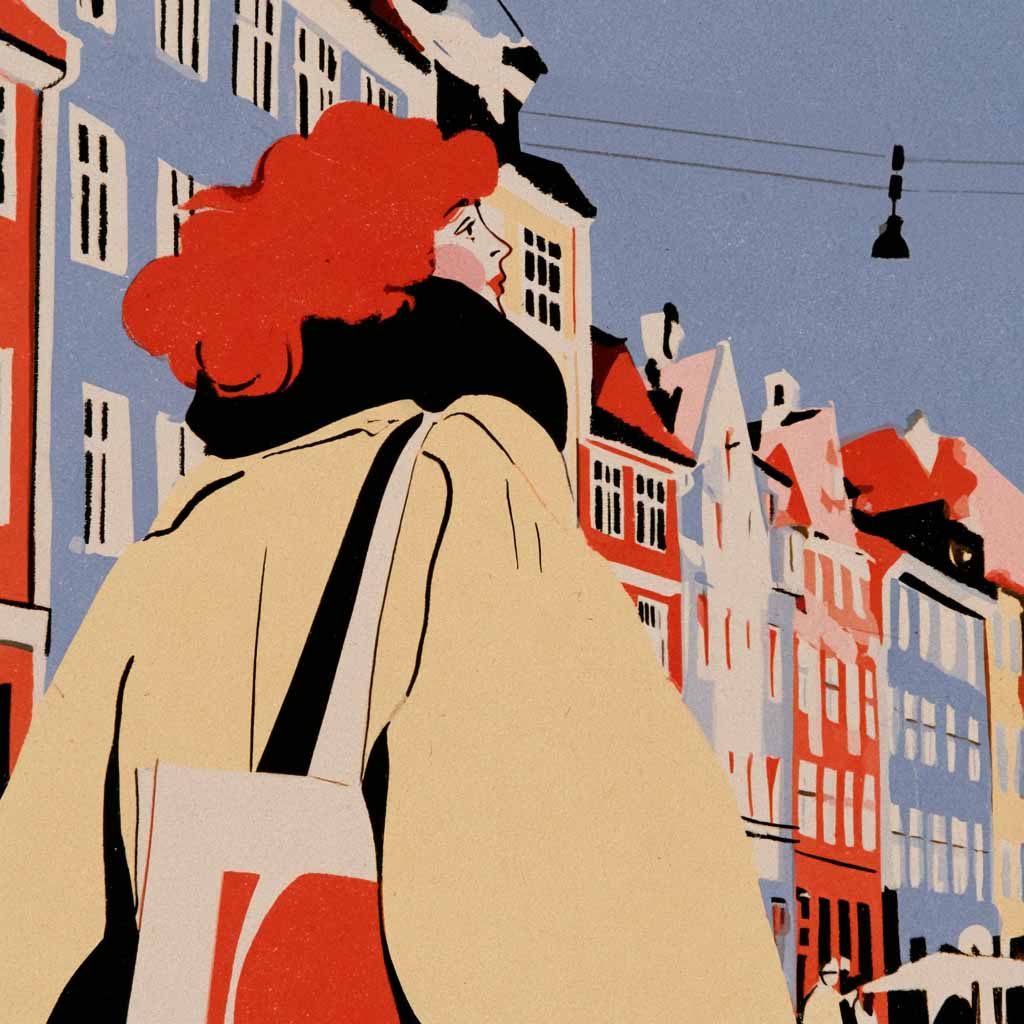
newcomers to copenhagen, made with Midjourney by Kay Xander Mellish
Podcasts, Stories about life in Denmark

13 Quick Tips for Newcomers to Copenhagen

Since I’ve lived in Denmark for some time, it can be hard to get in the headspace of a newcomer.

But that was my assignment recently when I spoke to a couple of hundred new students at the University of Copenhagen, who had just arrived in Denmark the day before.

I thought that some of these tips might be useful to you, my podcast listeners.

So here we go, lightning round, word association style.

Get an ugly bicycle in Copenhagen

Bicycle. When you arrive in Copenhagen, get one quickly, and get an ugly one. Don’t get a fancy one that is exciting to thieves. Denmark has a bicycle culture, but it also has a big bicycle theft culture.

A good option is a second-hand bike, but get it someplace legit, because if you get it from some random online you might find yourself riding someone else’s stolen bike.

Biking gives you freedom, it can take you anywhere at any time in any season in Denmark. And if you don’t know how to ride a bike, the Danish Red Cross has free classes for adults.

Yes, you do have to pay for public transport in Denmark

Transport tickets. There are no fare gates on the Danish metro or bus or train. You’re just trusted to buy a ticket.

However, there are controllers that go around and check, and if you don’t have precisely the right ticket when they check you, you will get a big fine.

Don’t bother with a dramatic story about how you didn’t understand the ticket system because you’re an innocent child from a faraway land.

Don’t cry. It doesn’t work, I’ve tried.

Keep your dignity, pay the fine, and then if you think it’s unfair, email the transport company. You can often get the fine reduced, in particular if it’s your first fine.

First names only in Danish culture

First names only. In Denmark, everybody goes by their first name. That includes university professors, bosses, priests, schoolteachers, doctors, even the prime minister. Mette. Mette Frederiksen.

Nobody uses Mr or Mrs or Doctor titles.

This is also true for older people. You don’t have to address them as Ma’am or Sir or Aunty or any of the other forms of respect common in other cultures. Just their first names – it’s what they want.

Always be on time in Denmark

Time and trust: Being on time is a big part of building trust in Denmark. A 10am class really is a 10am class, a 2pm meeting really is a 2pm meeting, and even for social events you have to be on time.

If someone invites you for dinner at 7 you really have to be there at 7.00.00. Otherwise your food will be cold. None of this turning up fashionably late.

And if you say that you’re going to be someplace, you really do have to turn up, or the Danes will be heartbroken. They were counting on you.

Splitting the check on a date in Denmark

Dating. Dating in Denmark is very egalitarian. The check is usually split in half. If it’s a male female date, the man may offer to pay, the woman might say no, and that doesn’t mean the date is a flop. People just like to be equal.

In general, Danes can be prickly about someone else picking up the check in a restaurant, even with friends – they do not want to feel obligated. Usually everyone splits the bill.

The exception is your birthday, when you pay for everything.

How to party if you don’t drink alcohol in Denmark

Drinking. Not all of Danish social life still centers on alcohol, but a lot still does. If you don’t drink alcohol , I’d recommend going to parties and Friday bars anyway and having elderflower juice, hyldeblomst. It’s a local favorite, light and sweet with zero alcohol.

You can also have what they call danskvand, or Danish water, that’s just plain water with bubbles in it. Put in a lemon or lime, it looks like a cocktail, nobody’s going to ask you any questions.

If you do drink alcohol, beer is generally pretty cheap in Denmark, wine less so, and cocktails very expensive. It’s common for a group of friends to drink at home before they go out to save money. (The Danes call it warm, in other words, warming up to a night on the town.)

Saving money in Copenhagen

Saving money. Restaurants and cafés and takeout are all very expensive here, so you’ve got to learn to cook for yourself or you’ll go broke. Look for items in supermarkets with yellow labels. Yellow is the color of discounts in Denmark.

Supermarkets often cut the price on food the day before it goes out of date. If you eat meat, you can buy a lot of this discount about-to-expire meat, freeze it, and eat it whenever you like. (I also recommend the app To Good To Go which offers discounts on “surprise bags” of bakery products, sushi, and other about-to-expire food as an initiative to avoid food waste.)

One thing you cannot do here is negotiate a discount at the supermarket checkout, and yes, I have seen people try. Flea markets, yes, supermarkets no.

You’ll notice that many of the staff in supermarkets are under 18. That’s because employers are legally allowed to pay young people less.

Your doctor in Denmark

Your doctor. Every person in Denmark legally gets to choose a primary care doctor, this is the famous tax-funded universal care. The doctors are self-employed, they own their clinics, but they are paid by the government, you don’t pay to see them.

What you do have pay for is medicine. If you need a prescription, they’ll send it electronically to a central system and you can pick it up at any pharmacy in Denmark, the price is the same everywhere.

That said, Danish doctors are often reluctant to prescribe medicine, in particular sleeping medication and antibiotics. These are t ough to get.

When you need someone to talk to in Denmark

Mental health. It’s August, it’s the light times, now is the time to start finding friend groups and activities, because the dark times are on their way. You do not want to be sitting all alone in your room during the dark times – November, December, January, February.

If you’re in Denmark and feeling alone and desperate, and the wait to talk to your doctor or to a free public counselor is too long, you can always make an appointment with a Danish priest.

Now, don’t freak out. You don’t even have to be a Christian! In the Danish state church, the priests are often middle-aged women. They’re not going to wear a funny outfit or talk too much about Jesus. They’ll just listen to you.

If you really need someone to talk to, a Danish priest from the state church is available in every neighborhood in Denmark. It’s fast, and it’s free. Don’t wait.

(Find your local branch of the state church in Denmark here.)

Hanging out with the Danish Royal Family

The Danish Royal Family. They are not big celebrities like the British Royal Family, you will see them walking around, especially in Copenhagen. I remember when I first got here looking through the window of a hair salon and seeing the then-Queen getting her hair washed.

If you’re a young person like the people in my university audience, you might see Crown Prince Christian, the future king, out having a few beers. He’s 20, whatever, he likes beer. Same for his sister, who is 19 and currently in the Danish Army. When she gets a break she probably likes some beers as well.

If you’re single and heterosexual, keep in mind that Danish Royals always marry foreigners, never other Danes. The current King married a woman from Australia, his Mom married a Frenchman, his grandpa a Swede, his great-grandpa a German. So you have a chance.

Quiet, taxis, gifts in Denmark

Quiet. Denmark is a quiet country. You might be on a bus or a train FaceTiming with a friend at home and see a Dane looking at you in a disapproving way.

You might think it’s because you are a foreigner, and that could be true, but it could also be because you’re loud.

With the exception of those drunken Friday bars, this is a quiet country.

Listen to the traffic: there are almost no horns honking. Most Danish trains have a “silent car” where no one is allowed to talk or play music.

Danes like peacefulness. If you are loud, voice loud, music loud, TikTok on your phone with no earphones loud, any type of loud, you are going to get funny looks.

Taxis. Taxis aren’t as common here as they are in many other big cities, because public transport is reliable and clean and used by every social class. And taxis are expensive.

You can’t really call a taxi by raising your arm like you do in Hong Kong or New York City.

You have to go to a taxi stand or call a taxi to where you are, or use the local taxi app. And the local version of Uber is just another version of the local taxi app.

If you absolutely must use a taxi, perhaps if you have a lot of luggage, use the fixed price option in the app. This will help you avoid getting an unscheduled tour of the city.

Gifts. In many countries, gifts are a social cue and and important part of doing business, but not in Denmark.

You should never give your professor or your boss flowers or candy or any other kind of gift. They’ll be very uncomfortable if you do. They see it as a form of corruption, which is not OK in Denmark.

You also should not offer money to university administrators to get what you want, such as a better housing assignment, or to municipal officials or immigration staff to get them to bend the rules.

They will be angry if you do. This is not the Danish way.

Danish dinner party customs, image by Kay Xander Mellish 2026
Podcasts, Stories about life in Denmark

Why it’s OK to break your Royal Copenhagen porcelain

Some might say that the most Danish piece of furniture is the chair. The Swan Chair, the Egg Chair, the Wishbone chair. They’re all international design classics. You can buy a poster with 100 of the top Danish chairs, and if you go to Designmuseum Danmark there is a hall of chairs you walk through, the display cases stacked three high. Chairs, chairs, everywhere.

But I think the most Danish piece of furniture is the table. It is where traditional Danish cuisine is enjoyed, and sitting around the table, and sitting and sitting and sitting there for hours after a long meal, is where hygge reigns and people are included – or excluded, as the case may be.

Continue Reading

Dating, Podcasts, Stories about life in Denmark

Romance in Denmark

I talk a lot in my speeches about how people bring their own work culture with them when they come to work in Denmark, but they also bring their own dating culture.

The way you expect to meet a potential partner, to flirt, to show you’re serious, to take the relationship to the next level, these are expectations you bring with you to Denmark from your home culture.

When you get here, you will meet Danes who have very different expectations.

Romance in Denmark

Denmark’s doing a big recruitment campaign now, trying to get young professionals to bring their skills to Denmark, and a lot of them are single when they arrive.

If they want to meet someone and don’t meet someone, and if they want a serious relationship and a family but can’t get started, they often go home again.

So, in the name of economic development, here are my tips on romance in Denmark.

Continue Reading

Stories about life in Denmark, Travels in Denmark

The Bridges of Denmark

I don’t do a lot of stock market investing, but if I did, I’d want to go back in time and invest in companies that build bridges in Denmark. This country is on a tear when it comes to bridge building. Over the past decade, there have been 5 new major bridges in Copenhagen alone, and at least one new major one is planned.

And because this is Denmark, and people love design, each bridge has its own special look. You can’t just put up a few bridge supports and a deck on top for traffic. You need style, and you need a colorful name.

Consider, for example, the multicolored Kissing Bridge in Copenhagen. It’s not named that because you’re supposed to kiss on the bridge, although you can if you like. It’s named that because it breaks in half on a regular basis to let ships through, and then it’s supposed to come together again like a kiss.

The Kissing Bridge has needed to visit a relationship counselor, however, because there have been constant problems getting it to kiss. It wasn’t quite aligned the way it was supposed to be.

It seems to work now, although it’s rather steep and a difficult ride for bicyclists, which is rather a shame, because it is a bicycle and pedestrian bridge only. There are no cars on it.

Bicycle Snake and Brewing Bridge

The Bicycle Snake and the Brewing Bridge a little further down the harbor are also just for cyclists and walkers, and so is the Little Langebro bridge.

The Little Langebro bridge is currently the newest bridge in town, just a couple of years old. This is a neighborhood I don’t go to often, and I remember coming home from a late night engagement to suddenly find a new bridge in front of me, all lit up and ready to serve.

Whoa! Unexpected bridge. It was like a dream.

Continue Reading

Podcasts, Stories about life in Denmark

Gender equality in Denmark: A story of mixed results

Denmark has had two female prime ministers and about forty percent of the people elected to the Folketing, the Danish Parliament, are women, which one might think is a good indicator of gender equality in Denmark.

But when it comes to private industry, Danish women have one of the lowest participation rates in management in Europe. According to the OECD, only 26.9% of managers in Denmark are female, compared to 40.7% in the US.

It’s not unusual to see a senior management team made up entirely of Danish males, with perhaps a Swedish or German male thrown in for diversity.

Continue Reading

Podcasts, Stories about life in Denmark

Animals and Denmark – and which animal represents Denmark best?

Among the many cultural questions I ask audiences during my How to Live in Denmark Game Show is “Which animal represents Denmark best?”?

There never seems to be an obvious or generally agreed-upon answer. Sure, the bear represents Russia, the elephant Thailand, and the bald eagle the United States. But what about Denmark?

Denmark does have a national animal – the mute swan (Cygnus olor) – but an image of a swan doesn’t provoke the kind of immediate association with Denmark that, say, a koala bear does with Australia.

That said, mute swans are easy to find in Denmark. You can see them sailing down the quiet streams of the country’s historical parks, such as the vold in Fredericia or Utterslev Mose in suburban Copenhagen.

But these strong, individualist, and often angry animals are a strange fit for a country that prides itself on co-operation and peacefulness. They’re also not really mute – in fact, they have a noisy hiss that can signal an attack if they feel their nest is threatened.

Given that these muscular birds are about a meter tall and their wingspan can be twice that, you may feel threatened too.

Continue Reading

Podcasts, Stories about life in Denmark

Drinking in Denmark

Earlier this year, my daughter and I visited several Danish high schools to help her decide where she’ll continue her education. We looked at the classrooms, and at the laboratories – my daughter likes science. We looked at the athletic faculties, and we looked at the bars.

Yes, most of the high schools we visited had a bar, or at least a café where they serve the students beer on tap, or hard cider in cans, or alco-pops in bottles when they want to relax after class.

Now, high school students are usually 16 to 19 years old, and the legal purchase age for wine and beer in Denmark is 16, so it’s all totally legal.

It’s just a bit surprising when you come from anyplace where teenagers are encouraged not to drink alcohol to find a bar conveniently located next to the school gym.

Continue Reading