
Watching movies and TV is a great way to get through the long Danish winter, and if you watch Danish movies or TV series, it’s also a great way to learn Danish or learn about Danish culture.
Many newcomers to Denmark tell me they’ve been watching recent shows, like Borgen or The Bridge or The Killing. Or maybe movies like Another Round, which won an Oscar for Best International Feature, or The Hunt, both of which star Mads Mikkelsen, Denmark’s most recent contribution to the world of movie stars.
I saw Mads at the Copenhagen Opera recently, just standing by himself in the lobby with a glass of champagne, no one bothering him.
When you start watching Danish films, you’ll probably want English subtitles, but as your knowledge of Danish grows, it’s great to try out the Danish subtitles. That will help you bridge the gap between spoken Danish and written Danish, which don’t always resemble each other if you’re not a native speaker.
Making movies since 1897
Denmark has been serious about moviemaking for more than a century. The first Danish film, made in 1897, was called Driving with Greenland Dogs. Filmed in a Copenhagen park, it’s a guy with a dogsled in the snow. 30 seconds long.
Soon after that the Nordisk Film company was founded. It is the world’s oldest continuously operating film studio. Founded in 1906. If you go to the cinema in Denmark today, the show often starts with a Nordisk Film logo.

Poul Reichhardt
Whatever type of movie you like, Denmark has probably made it since then. I’m a fan of film noir myself, those black and white crime dramas from the 1940s and 50s with a femme fatale, and I recently watched a great Danish film noir called Two Minutes Too Late.
It stars Poul Reichhardt, who is kind of the Cary Grant of Danish movies, the mid-century hunk, as a handsome playboy being blackmailed by an old girlfriend.
Suddenly, she turns up dead. Did he do it?
Comedy from The Olsen Gang
But if you prefer comedies, the Olsen Gang series might be for you. The Olsen Gang is three lovable, bumbling, a little bit shabby comic criminals, who are almost never violent.
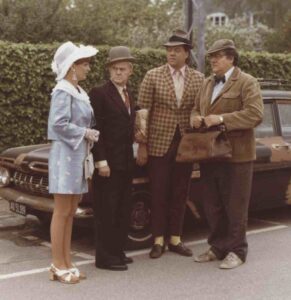
The Olsen Gang
The Olsen Gang movies always start the same way – Egon Olsen walks out of prison and meets his buddies Benny and Kjeld, and they immediately begin making elaborate plans for their next caper.
Their clever schemes inevitably go wrong, and at the end, Egon Olsen usually gets arrested again.
Father of Four and Jante Law
The Olsen Gang movies are great for kids, and so is the Father of Four series, which goes back many decades. And unlike the Olsen Gang, there are still new episodes. They just keep replacing the actors who play the main characters – the single father with four lovable kids.
One of the most recent installments, from 2018, has the family at a holiday resort, facing off in a contest with a villainous family who pushes their children too hard.
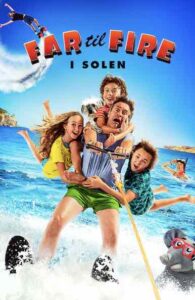
Father of Four
The bad family makes their children learn violin and go to ballet classes and study hard in school, while our heroes relax and enjoy “free play” in the contemporary Danish child-raising manner.
There’s not a lot of suspense, so I’ll give away the ending – both families unite onstage and sing a song called “You Are Good Enough as You Are”.
It’s basically a musical version of Denmark’s famous Jante Law of enforced modesty. The bad family has learned that they shouldn’t try to be better than other people. That’s Jante Law.
See Danish films for free
Where can you see Danish movies like these? If you’re in Denmark, you can see films for free via the library system. A service called Filmstriben offers films from all over the world, and lots from Denmark.
You sign up with your CPR number and use it just like Netflix, streaming movies at your convenience.
This only works from within Denmark. The same is true for Denmark on Film, which shows documentaries and old footage from around the country, plus the Faroe Islands and Greenland.
The fun thing about Denmark on Film is it has a map where you can find any geographical location, like your town or your street, and find historical footage about that place.
Two great vintage TV shows
DR.DK, the national broadcaster, has a selection of movies and TV series online, and you can usually access them outside of Denmark, certainly with a VPN.
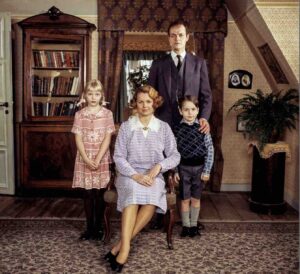
Matador
If you like vintage shows from your own culture, you might like the Danish classic like Matador, which is a multi-part series about a fictional Danish town before and during the Second World War. With lots of interlocking plots and characters – the rich, the poor, the Resistance, the Nazis, it will get you through many dark winter nights.
Matador is deeply beloved in Denmark.
The Danish version of Monopoly is called “Matador”. And you can visit a real-life version of the fictional town in the Bakken amusement park north of Copenhagen.
Matador is a drama, but if you prefer comedy, another vintage show available on DR.Dk is House on Christianshavn.
It’s set in a working-class district of Copenhagen during the 1970s, and the characters have all sorts of interactions and humorous misunderstandings.
Children’s shows are great for all ages
DR.DK also has a wonderful selection of Danish-language children’s programming.
I often recommend this to adults who are just getting started learning Danish, because the language is so simple and straightforward, and the simple songs for children stick in your head.
It’s all tax-financed
All of this is paid for by our giant Danish taxes, of course. And almost all of the contemporary film production in Denmark is supported by taxes too.
The Danish Film Institute, which is part of the Ministry of Culture, gives subsidies for scriptwriting, development, and production. And in the Danish spirit of transparency, you can see online exactly which films get how much money each year.
The Danish government also forces Netflix and other big streaming services to contribute to Danish-language production. Netflix has even made a couple of new Danish-language TV series recently.
I like this idea of keeping Danish film media fresh and current and relevant. It’s all a part of making sure that Danish-language movies and TV survives in an increasingly English-speaking world.